
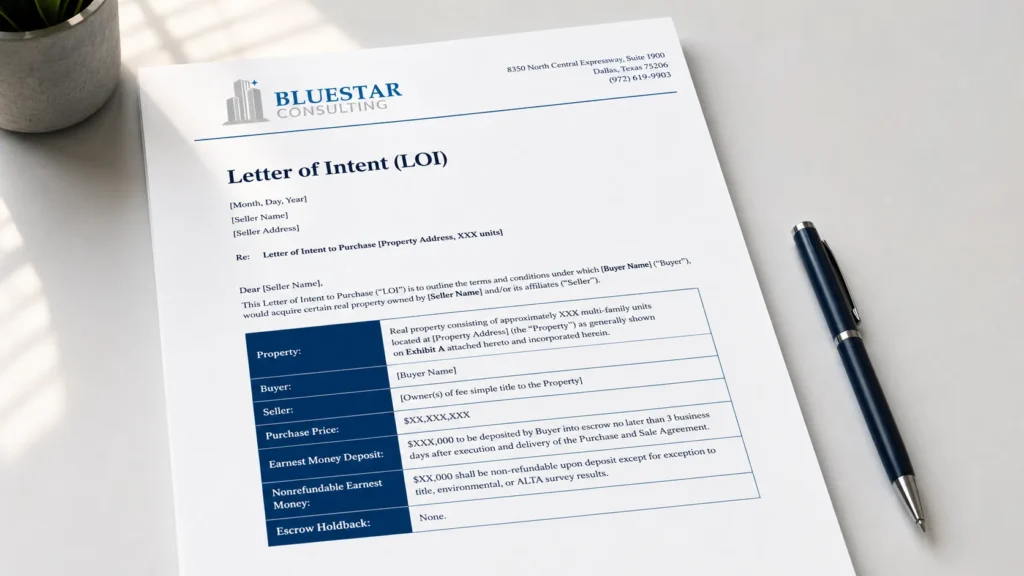
So you found a commercial real estate property you want to buy. Now what? Before the lawyers get involved, before the title company opens a file, before anyone signs a 40-page purchase and sale agreement, there’s a straightforward document that sets up the deal and puts things in motion. It’s called the letter of intent, or LOI for short. Let’s break it down.
What an LOI Actually Is
A letter of intent (LOI) is a written expression of a buyer’s serious interest in a commercial real estate property, laying out the core terms both sides are willing to work from: price, key dates, major contingencies, and deal structure. Think of it as a handshake with a paper trail. It’s not exactly a binding contract, but rather a signal that both parties are ready to get serious, and a roadmap for the purchase or lease agreement that follows.
Most LOIs are intentionally non-binding on the big-picture terms, while a few specific clauses (confidentiality, exclusivity, and who pays for what if the deal falls apart during due diligence) are often carved out to be binding. That distinction matters, and it’s one of the first things a sharp negotiator checks before signing anything.
Why the LOI Punches Above Its Weight
It’s Cheap and Opens the Door to Due Diligence
Drafting a full purchase and sale agreement takes attorneys, time, and money. Nobody wants to pay for that lift only to find out the buyer and seller were $2 million apart on price the whole time. The LOI is the low-cost filter that surfaces deal-breakers before anyone burns real legal fees.
It Sets the Emotional Tone of the Negotiation
The LOI stage is where posture gets established. Is the buyer aggressive or measured? Is the seller motivated or just testing the market? These signals show up in how quickly an LOI comes back, how many terms get pushed back on, and how the redlines read. Read those signals well, and you walk into the purchase agreement already knowing your leverage.
It Locks In Exclusivity and Buys You Time
A well-drafted LOI often includes an exclusivity or “no-shop” clause, meaning the seller agrees to pause marketing the property to other buyers while due diligence and contract negotiation happen. For a buyer, this is gold: real estate deals live and die on time, and exclusivity keeps a hot property from getting scooped out from under you mid-negotiation.
It Forces Clarity on the Stuff That Actually Kills Deals
Price gets the headlines, but deals more often collapse over financing contingencies, closing timelines, earnest money terms, and who’s responsible for what during due diligence. A good LOI puts these on the table early, when walking away costs nothing, instead of discovering a dealbreaker three weeks into a $50,000 legal bill.
It Becomes the Skeleton for Everything That Follows
Every major term in the purchase agreement traces back to the LOI. Attorneys on both sides use it as their drafting reference. A sloppy or vague LOI creates ambiguity that gets fought over later. A sharp, specific LOI makes the contract-drafting phase faster, cheaper, and far less contentious.
The Anatomy of a Deal-Ready LOI
The strongest LOIs are short on legalese and detailed in clarity. At minimum, expect to see:
- Purchase price and deposit structure: the number, and how earnest money will work
- Due diligence period: how long the buyer has to inspect, and what happens to the deposit if they walk
- Financing contingency: whether the deal depends on the buyer securing a loan, and the timeline for that
- Closing timeline: target date, and what triggers extensions
- Key conditions: environmental reports, zoning confirmation, estoppel certificates, whatever is deal-specific
- Exclusivity period: how long the seller agrees to stay off the market
Don’t Make the Rookie Mistake
The most common error isn’t a missing clause. It’s treating the LOI as a formality to rush through instead of the negotiation it actually is. Buyers who blow through the LOI stage to “get to the real contract faster” often end up re-litigating terms they thought were settled, because nothing was actually agreed to in writing. The LOI isn’t a warm-up. It’s the first step in a successful negotiation to acquire more property.
Last Words
The letter of intent sets the terms and precedent for how to get to the closing table. It’s direct, it’s cheap, and it’s the single best tool for finding out, before anyone spends real money, whether a deal is actually a deal. Skip it, and you’re not saving time or money. You’re just moving the hard conversations to a much more expensive stage of the process.
You can have an attorney draft an LOI for you and continually reuse that template. If you want to be really economical about it, you can find templates online and adapt them for your own use. However, it is always recommended to have an attorney, or at the very least, a seasoned real estate professional, review the document before submitting an LOI for a prospective property.
*LOIs are also used in lease negotiations for commercial properties.
How BlueStar Consulting Approaches LOI and Deal Support
BlueStar Consulting works alongside investors during the LOI stage of a commercial real estate acquisition, helping stress-test the price, contingencies, and timeline a letter of intent proposes before it goes to the seller. That early read feeds directly into the due diligence and underwriting work BlueStar builds once the LOI is signed and exclusivity begins.
Developers and investors preparing to submit an LOI on a commercial property can engage BlueStar’s team of underwriting and market analysis specialists to confirm the numbers behind the offer before it’s on paper.
Frequently Asked Questions
Is a letter of intent legally binding in a real estate deal?
Most of an LOI is intentionally non-binding, meaning either party can walk away from the core deal terms without legal consequence. Specific clauses within the same document are usually carved out to be binding regardless: confidentiality, exclusivity or no-shop provisions, and cost allocation if the deal falls through during due diligence. Whether a given LOI is binding or non-binding depends entirely on its exact language, which is why reviewing that language before signing matters more than assuming based on the document’s name.
What is the difference between an LOI and a purchase and sale agreement?
A letter of intent is a short, informal document outlining the core terms both parties are working from, typically a few pages. A purchase and sale agreement (PSA) is the full, legally binding contract that governs the actual transaction, typically dozens of pages covering every contingency, representation, and closing mechanic. The LOI comes first and sets the terms the PSA is drafted around. The PSA is what actually transfers the property at closing.
How long does LOI negotiation typically take in commercial real estate?
LOI negotiation in commercial real estate usually takes anywhere from a few days to two or three weeks, depending on how far apart the buyer and seller start and how many rounds of redlines the terms go through. A straightforward deal between motivated parties can close out an LOI in under a week. A more contested negotiation, especially around price or exclusivity length, can stretch longer before both sides sign.
Can a seller accept multiple LOIs at the same time?
Yes, until an LOI includes a signed exclusivity or no-shop clause, a seller is generally free to continue marketing the property and entertaining competing letters of intent from other buyers. This is exactly why exclusivity terms matter so much to a buyer: without them, a seller can use one buyer’s LOI as leverage to extract a better offer from another. Once exclusivity is signed, the seller is contractually obligated to pause that process for the agreed period.
Who pays for due diligence costs during the LOI period?
Cost allocation during due diligence, covering items like environmental reports, surveys, and inspections, is typically negotiated directly in the LOI itself. Many LOIs specify that each party bears its own due diligence costs regardless of whether the deal closes, since this is one of the clauses commonly carved out to be binding even when the rest of the LOI is not. Buyers should confirm this allocation explicitly rather than assume a default, since practice varies by market and deal size.
Does an LOI need to include a specific purchase price, or can it reference a range?
A letter of intent can technically reference a price range or a formula-based price, but most experienced negotiators recommend a specific number. A range leaves the most consequential term of the deal unresolved, which defeats much of the LOI’s purpose as a filter for deal-breakers before legal fees start. A specific price forces the real conversation to happen early, when walking away still costs nothing.