

When an appraiser values a commercial property using the sales comparison approach, the first question is data: recent, verified transactions in the same submarket, pulled from CoStar or county deed records. The analysis does not start with a formula. It starts with finding genuinely similar properties that have actually sold.
This article covers how CRE professionals source comparable sales, how appraisers apply the six standard adjustment categories, which unit of comparison applies to each asset type, and when the sales comparison approach is not the right tool for the job.
| The sales comparison approach, also called the market data approach, estimates a commercial property’s value by analyzing recent sales of similar properties and adjusting for differences between each comparable and the subject property. It is the primary valuation method when sufficient transaction data exists in the market: most reliable for land, industrial, multifamily, and standard retail assets in active submarkets. Appraisers source comparable sales from CoStar, LoopNet, and county records, then apply adjustments across six categories: location, physical characteristics, market conditions, property rights, financing terms, and economic characteristics such as lease terms. When comparable sales data is thin or the property is a specialty asset, the income approach or cost approach typically takes precedence. |
What Is the Sales Comparison Approach? (Also Called the Market Data Approach)
The sales comparison approach, also called the market data approach, estimates a commercial property’s value by analyzing recent sales of similar properties and adjusting for differences between each comparable and the subject property.
It is the primary valuation method when sufficient transaction data exists in the market: most reliable for land, industrial, multifamily, and standard retail assets in active submarkets. When comparable sales data withing comparative market analysis (CMA) is thin or the property is a specialty asset, the income approach or cost approach typically takes precedence.
The underlying principle is substitution: a rational buyer will not pay more for a property than the cost of acquiring an equivalent substitute in the open market. If three comparable industrial buildings in the same submarket sold between $125 and $140 per square foot in the past six months, a fourth similar building should trade within or near that range, adjusted for meaningful differences. That logic governs every step of the sales comparison analysis.
When Appraisers Use the Sales Comparison Approach as Primary Method
The market data approach functions as the primary valuation method when the market provides sufficient, recent, arm’s-length comparable sales data. For land, industrial, and stabilized multifamily assets in active submarkets, it often carries the most weight because those asset types trade frequently enough to produce reliable price signals.
For complex income-producing properties with significant variation in lease structures, tenant credit, and cash flow, the income approach typically dominates. For specialty assets with thin transaction history, the cost approach may become the primary method.
How to Find Comparable Sales in Commercial Real Estate
The most common failure in a sales comparison analysis is not in the adjustment methodology. It is in comp selection: the comps must be genuinely comparable, not merely superficially similar. The right data sources and the right selection criteria determine whether the analysis is defensible.
Data Sources: CoStar, LoopNet, and County Records
CoStar is the primary data source for verified CRE comparable sales in the U.S. market. Subscription access provides confirmed sale prices, transaction dates, buyer and seller identities, and property-level detail across all major asset classes.
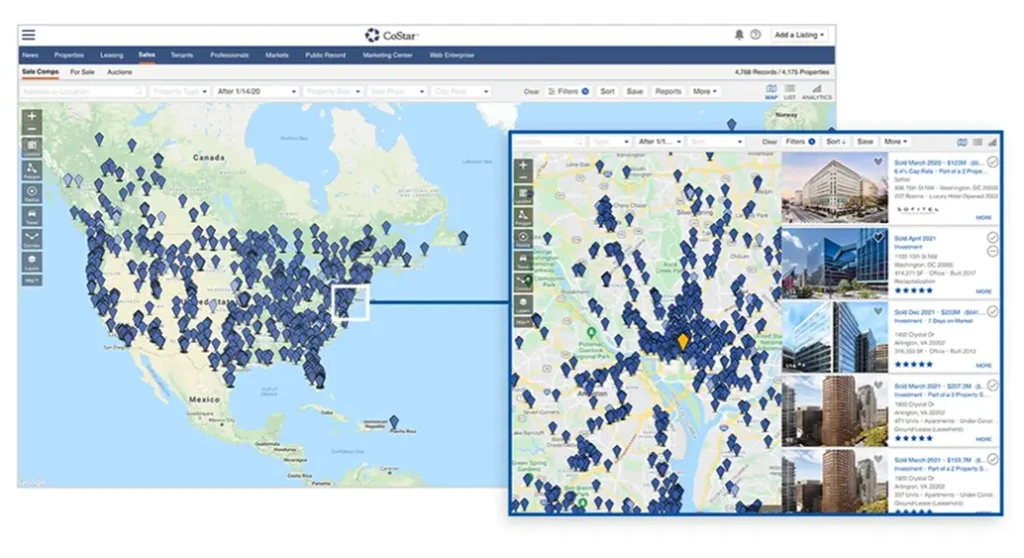
CoStar’s verification process reduces the risk of relying on unconfirmed or misreported sale prices. LoopNet, which operates under the same parent company but offers broader public access, is useful for initial screening and in markets where CoStar coverage is thinner. County deed and property tax records serve as the public record for transaction confirmation. Appraisers cross-reference CoStar data against county records to verify that the reported sale price matches the transfer documentation, which can reveal seller concessions or non-arm’s-length conditions that distort the price.
What Makes a True Comparable in CRE
A valid commercial comparable must meet a specific set of criteria: same property type, same or competing submarket, similar highest and best use, comparable size within a reasonable range, and an arm’s-length transaction with no distress or unusual financing. On timing, appraisers generally require sales from the past six to twelve months in stable markets, or three to six months in volatile conditions.
A forced sale, a sale between related entities, or a transaction that bundled personal property into the price all compromise the comp’s reliability. Appraisers document why each comp was selected and why any apparent comparable was excluded.
Making Adjustments: The Six CRE Adjustment Categories
Once comparable sales are identified, the appraiser adjusts each comp to account for differences between that property and the subject. The direction of adjustment follows a counterintuitive rule: when the comparable is inferior to the subject, the appraiser adds to the comp’s price. When the comparable is superior, the appraiser subtracts. The six standard categories, codified in USPAP (Uniform Standards of Professional Appraisal Practice), cover every material difference between a comp and the subject property.
Property Rights Conveyed
This adjustment addresses whether the comp sold as fee simple ownership or subject to existing lease obligations. A property sold with a below-market lease already in place transfers with an encumbrance on income potential. The appraiser adjusts downward from the comp’s price to reflect that the subject may be unencumbered, or in the opposite direction if the subject carries the below-market lease. This adjustment is particularly relevant for office and retail properties where long-term leases lock in below-market rental rates.
Financing Terms and Conditions of Sale
A sale that included seller financing at below-market interest rates does not reflect true arm’s-length market value. Seller-financed transactions often achieve higher reported sale prices because the financing subsidy is embedded in the purchase price. Distress sales from foreclosure or receivership often trade at discounts that do not reflect stabilized market value. Both conditions require adjustment to remove the financing or distress effect before the comp can be applied to the subject.
Market Conditions (Time Adjustments)
Commercial real estate markets move. A comparable sale from twelve months ago may reflect a different interest rate environment, a different cap rate (capitalization rate) level, or different supply conditions than exist at the appraisal date. Appraisers derive time adjustments from market evidence, such as repeat-sale pairs or tracked trends in price per square foot, not from opinion alone. In markets that saw rapid cap rate compression or expansion, the time adjustment can be material.
Location and Submarket
Location differences require adjustment when they affect value. A retail property with direct freeway frontage commands a premium over a comparable property in a secondary corridor. An industrial building adjacent to a major logistics artery trades differently from one requiring a longer route to the highway. Corner lots, transit proximity, visibility from primary roads, and submarket quality all drive location adjustments grounded in market evidence.
Physical Characteristics: Size, Age, and Condition
Physical differences are the most straightforward adjustment category but require CRE-specific application. Price per square foot often varies with building size: a large building may trade at a lower per-SF price due to a thinner buyer pool and longer absorption time.
Year built, HVAC condition, clear height for industrial (a 24-foot clear building and a 36-foot modern distribution facility serve different users at different rent levels), parking ratios for office and retail, and deferred maintenance all require systematic adjustment.
Economic Characteristics
Economic characteristics capture differences in how the property generates income at the time of sale. A comp sold with stabilized occupancy at market rents is economically different from a subject with significant vacancy or below-market leases in place. Lease term length, net versus gross lease structure, tenant credit quality, and operating expense pass-throughs all affect buyer underwriting and therefore price paid. For income-producing assets where cash flow analysis drives value, the income approach typically carries more weight, as covered in the income approach article in this valuation series.
Price Per Square Foot vs. Price Per Unit: Which Unit of Comparison to Use
The unit of comparison is the metric by which appraisers express and compare sale prices across comps. In commercial real estate, the correct unit depends on the asset type. Using the wrong unit produces distorted comparisons and unreliable conclusions.
| Asset Class | Standard Unit of Comparison |
| Office | Price per square foot (SF) |
| Industrial / Warehouse | Price per SF |
| Retail (anchored and strip) | Price per SF |
| Multifamily / Apartment | Price per unit (per door) |
| Hospitality / Hotel | Price per key (per room) |
| Land | Price per acre or price per buildable SF |
Multifamily is the most common source of unit-of-comparison errors. A 200-unit apartment property and a 50-unit property in the same submarket will show different price-per-SF figures because of building efficiency differences. Price per unit provides a more direct comparison of what buyers are actually paying at each size tier. Land comparisons require attention to entitlement status: raw land, land with entitlements, and land under a ground lease each warrant a different unit and comp set.
Reconciling the Comparable Values
After adjustments are made to each comparable sale, the appraiser has a range of adjusted values, not a single number. Reconciliation is the process of weighing those values to arrive at a final conclusion. A comp with fewer required adjustments and greater similarity to the subject carries more weight than one that required large positive and negative adjustments across multiple categories. The final value conclusion is not a mathematical average of the adjusted comparables. It is a judgment call supported by the analysis.
When the Sales Comparison Approach Breaks Down in CRE
The sales comparison approach is not universally applicable. Several conditions reduce its reliability to the point where it should serve as a secondary cross-check rather than the primary method.
Specialty and Single-Use Properties
Properties designed for a specific use with limited alternative uses, such as car washes, self-storage facilities in oversupplied markets, or single-tenant net-lease assets with short remaining lease terms, often have thin comparable sales data. The universe of buyers is narrow, transactions are infrequent, and existing comps may not reflect the same dynamics as the subject. The cost approach may serve as a primary or secondary check in these situations, as covered in the cost approach article in this valuation series.
Thin Markets with Insufficient Transaction Volume
In secondary and tertiary markets where commercial transactions are infrequent, finding six to eight arm’s-length comparables within the required time window may not be possible. Appraisers must either expand the geographic search area, extend the time window, or rely more heavily on the income approach. Expanding either parameter requires larger adjustments and increases uncertainty in the final conclusion.
Complex Income-Producing Properties with Variable Cash Flows
A multitenant retail center with significant vacancy, a mix of below-market and above-market leases, and a pending anchor departure does not compare cleanly to stabilized properties. Each comparable will require significant economic characteristics adjustments that introduce substantial uncertainty. In those circumstances, the income approach, which models the actual projected cash flows through a stabilization period, produces a more defensible value opinion.
Sales Comparison Approach vs. Income Approach: Which to Rely On
The sales comparison approach and the income approach answer different questions. The market data approach asks what buyers have paid for similar properties. The income approach asks what the subject property’s projected cash flows are worth to an investor today. For income-producing properties with stable, documentable cash flows, the income approach typically carries more analytical weight. The sales comparison approach serves as a market reality check: does the income approach conclusion fall within the range of what buyers are actually paying for comparable assets in the same submarket?
How BlueStar Consulting Approaches Market Analysis and Property Valuation
Evaluating a commercial property acquisition requires understanding which valuation methodology is appropriate for the asset type and whether the appraiser’s comp selection and adjustment rationale is defensible. BlueStar Consulting’s market analysis and property valuation work includes review of appraisal methodology as part of the broader due diligence and underwriting process.
Investors, developers, and brokers working through an acquisition, disposition, or financing transaction can engage BlueStar for market analysis and feasibility assessment grounded in current submarket data.
Frequently Asked Questions
What is the sales comparison approach in real estate?
The sales comparison approach estimates a property’s value by analyzing recent sales of comparable properties and adjusting each comparable to account for differences between it and the subject property. It is one of the three recognized appraisal approaches, alongside the income approach and the cost approach. In commercial real estate, it is most reliable for asset types with frequent transaction volume in the subject submarket: multifamily, industrial, land, and standard retail properties.
Is the market data approach the same as the sales comparison approach?
Yes. The market data approach and the sales comparison approach are two names for the same appraisal methodology. The term “market data approach” appears in older appraisal literature and some formal appraisal institute contexts. USPAP, which governs U.S. appraisal standards, uses “sales comparison approach” as the standard term. An appraisal report referencing either term is using the same underlying method: analyzing verified comparable sales and adjusting for differences between each comparable and the subject property.
How do appraisers find comparable sales for commercial properties?
CRE appraisers source comparable sales primarily from CoStar, which provides verified transaction data including confirmed sale prices, property details, and buyer and seller information. LoopNet is used for initial screening and in markets with thinner CoStar coverage. County deed and property tax records serve as the public record for transaction verification, cross-referenced to confirm that reported sale prices align with the transfer documentation. Appraisers document the comp search criteria and the reason any apparent comparable was excluded.
When is the sales comparison approach not appropriate for CRE?
The sales comparison approach becomes unreliable when comparable sales data is insufficient or non-existent. Specialty and single-use properties with narrow buyer pools, secondary and tertiary markets with infrequent transactions, and complex income-producing properties with significant vacancy or unusual lease structures all reduce the approach’s reliability. In those situations, the income approach or the cost approach typically serves as the primary method, with the sales comparison approach used as a secondary cross-check if any comparable data exists.