
The same commercial property can produce three legitimately different values depending on which appraisal method is applied. A developer who understands only the income approach interprets that range as error. A developer who understands all three sees it as information. The difference shapes how a deal is priced, how a loan is sized, and whether an acquisition pencils at all.
How to value commercial real estate? Commercial real estate is valued using three formal approaches recognized under USPAP (Uniform Standards of Professional Appraisal Practice): the income approach, the sales comparison approach, and the cost approach.
In a formal appraisal, a licensed appraiser calculates a value estimate under each method. The appraiser then weights and reconciles them based on which best reflects how the market prices that asset type.
Why Commercial Real Estate Valuation Differs from Residential
Income-Driven vs. Comparable-Driven
Residential property value is driven primarily by comparable sales. A three-bedroom house in a given neighborhood is worth approximately what similar houses have recently sold for. The income the property could generate as a rental is secondary, if it is considered at all.
Commercial property value is driven primarily by income. A retail strip center, an apartment complex, or an industrial warehouse is an income-producing asset. Its value is anchored to what it earns, what investors in that market expect to earn from similar assets, and how those expectations translate into a cap rate (capitalization rate). Comparable sales inform and validate the income-based conclusion, but they rarely drive it independently.
Why the Same Property Can Have Three Different Values
A value-add multifamily property generates below-market NOI (net operating income) today because of deferred maintenance and below-market rents. The income approach applied to in-place NOI produces a lower value. Applied to stabilized pro forma NOI, it produces a higher one.
The sales comparison approach produces a separate figure based on what comparable assets traded for. The cost approach produces another based on what it would cost to build a replacement asset from scratch, less accumulated depreciation. None of these figures is wrong. Each answers a different question.
The 3 Approaches to Commercial Real Estate Valuation
The Income Approach (Most Common for Income-Producing Properties)
The income approach estimates value by capitalizing a property’s NOI at a market-derived cap rate. The formula is:
Value = NOI / Cap Rate
If a stabilized multifamily property generates $600,000 in NOI and comparable assets trade at a 5.5% cap rate, the income approach produces an estimated value of approximately $10.9 million. A discounted cash flow (DCF) variant applies the same logic over a projected hold period. DCF in real estate is the preferred method for value-add or development assets where near-term income does not represent stabilized performance.
The income approach is the primary method for most income-producing commercial properties. For a full treatment of NOI calculation, cap rate derivation, and the direct cap versus DCF decision, see the income approach guide.
The Sales Comparison Approach (Also Called the Market Data Approach)
The sales comparison approach estimates value by comparing the subject property to recent sales of similar commercial assets, adjusted for differences in location, size, condition, and lease terms. This is a product of a comparable market analysis (CMA) phase. Results are typically expressed as price per square foot, price per unit, or price per door.
If three comparable industrial buildings sold between $120 and $135 per square foot over the past twelve months, an 80,000-square-foot subject property falls in an estimated value range of $9.6 million to $10.8 million before adjustments. Reliability depends entirely on the quality and volume of comparable transactions available. In thin markets or for specialty assets, this method may carry little weight.
For comp selection methodology, adjustment categories, and how appraisers handle price-per-unit versus price-per-square-foot comparisons, see the sales comparison approach guide.
The Cost Approach (New Construction and Specialty Properties)
The cost approach estimates value by calculating what it would cost to replace the subject property from scratch, then subtracting accumulated depreciation. The formula is:
Value = Land Value + Replacement Cost New – Depreciation
If land is worth $2 million, the structure costs $8 million to replace as new, and accumulated depreciation totals $1.5 million, the cost approach produces an estimated value of $8.5 million. This method is most relevant for new construction, owner-occupied properties that rarely trade, and specialty assets such as churches, schools, or data centers where comparable sales are sparse.
For depreciation types and how appraisers calculate replacement cost new for complex assets, see the cost approach guide.
How To Value Commercial Real Estate: Which Valuation Method Do CRE Appraisers Actually Use?
The standard presentation of the three approaches implies they are equally applicable to all property types. In practice, appraisers weight them according to what data is available and which method best reflects actual market behavior for the subject asset.
The table below summarizes the typical weighting pattern by asset type, consistent with IAAO (International Association of Assessing Officers) mass appraisal guidance and Appraisal Institute methodology literature.
| Asset Type | Primary Approach | Secondary Approach | Notes |
|---|---|---|---|
| Stabilized multifamily | Income | Sales comparison | Income drives conclusion; comps serve as market-reality check |
| Value-add multifamily | Income (DCF) | Sales comparison | Stabilized pro forma NOI used; DCF preferred over direct cap |
| Office (leased) | Income | Sales comparison | Income is primary; comps thin in many markets post-2020 |
| Retail (anchored) | Income | Sales comparison | Anchor lease terms heavily influence cap rate selection |
| Industrial / warehouse | Income | Sales comparison | Strong comp data in most major markets; both methods carry weight |
| Ground-up development | Cost | Income (DCF) | No in-place income; cost establishes baseline; DCF models projected stabilization |
| Specialty (church, school) | Cost | Sales comparison | Income rarely applicable; comps are often the only available check |
| Land | Sales comparison | Income (if income-producing) | Cost approach rarely applicable to unimproved land |
When Appraisers Use All Three and Reconcile Them
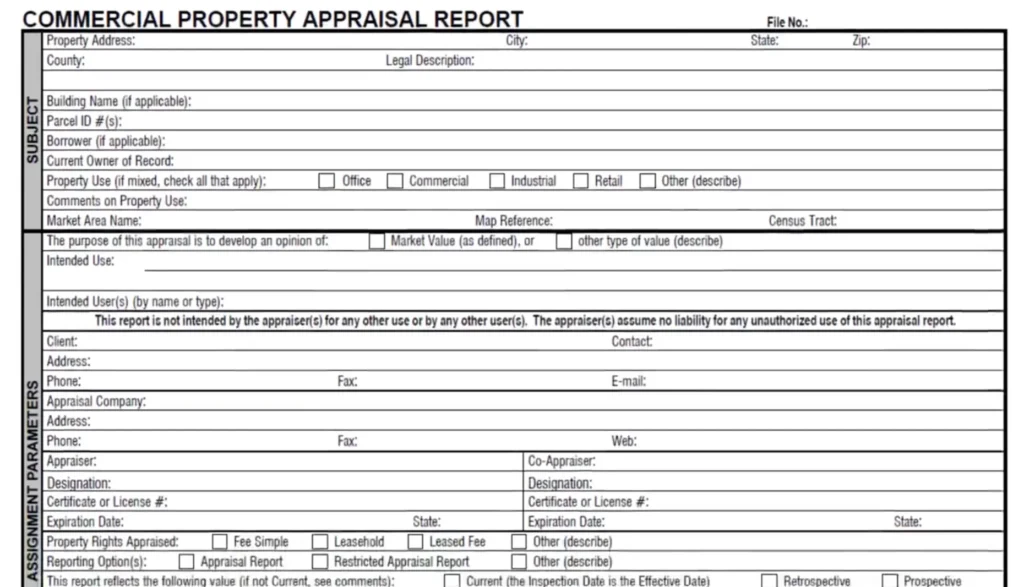
USPAP requires appraisers to reconcile the approaches they apply, weighting each method according to data quality and applicability to the subject property. The appraiser states the concluded weight explicitly in the appraisal report.
For a stabilized apartment complex, an appraiser might weight the income approach at 70% and the sales comparison approach at 30%, with cost approach assigned minimal weight. The final concluded value is the appraiser’s supported opinion anchored to whichever method most accurately reflects how investors in that market are actually transacting. Investors and developers who receive an appraisal report often read only the final value.
The reconciliation section, which explains how the appraiser weighted each method, contains the most useful information for understanding where inputs diverged from an internal financial model.
Key Factors That Influence Commercial Property Value
Location and Submarket
Location affects commercial value through achievable rents, vacancy rates, tenant demand, and investor appetite. Within the same metropolitan area, a multifamily property in a high-demand submarket may trade at a 4.5% cap rate. A comparable asset in a softer submarket may trade at 6.5%. That 200-basis-point spread represents a significant value difference for identical NOI.
NOI, Occupancy, and Lease Quality
For income-producing assets, the income approach converts NOI directly into value. Every dollar of NOI added or subtracted through occupancy improvement, rent growth, or expense reduction translates proportionally into appraised value. Lease quality, tenant credit, and remaining term affect how an appraiser or buyer underwrites that income. A property 95% occupied with month-to-month leases carries more income risk than one with long-term creditworthy tenants, and that risk will be priced into the cap rate.
Market Cap Rates and Interest Rate Environment
Cap rates compress and expand in response to capital availability, interest rates, and investor risk appetite, independent of any individual property’s income. A property that appraised at $10 million in a 5.0% cap rate environment may appraise at $8.7 million in a 5.75% cap rate environment on identical NOI. Developers and investors calibrating hold-period exit cap rate values need current submarket cap rate data, not trailing historical averages.
Property Condition and Remaining Useful Life
Physical condition affects value through multiple channels. Deferred maintenance depresses NOI by increasing operating costs and reducing achievable rents. It also affects the cost approach by increasing the depreciation deduction. Functional obsolescence, a layout or specification that no longer meets market demand, can reduce value independently of physical condition.
Common Valuation Mistakes Developers and Investors Make
Three mistakes appear consistently in deals where an internal valuation diverges from a third-party appraisal.
- The first is applying a stabilized NOI to a value-add property. Using a pro forma NOI that assumes lease-up or rent growth before that work is completed inflates the income approach value. Lenders apply their own underwritten NOI and the gap between the two determines loan sizing.
- The second is relying on a single-point valuation without scenario testing. A 50-basis-point movement in the exit cap rate at the end of a five-year hold can eliminate a material portion of projected equity value. Formal appraisals present a point estimate; investment decisions require a range.
- The third is ignoring functional obsolescence in the cost approach for older assets. A developer applying replacement cost new without accounting for obsolescence in the existing structure will overstate the cost approach estimate and misread how an appraiser or lender will weight it.
When to Get a Professional CRE Valuation
A formal appraisal by a licensed MAI (Member, Appraisal Institute) appraiser is required for most commercial mortgage transactions, institutional acquisitions, and tax, estate, or legal proceedings. A broker opinion of value (BOV) or internal model is not a substitute in these contexts.
Commercial appraisal fees typically range from $3,000 to $7,000 for standard multifamily or single-tenant commercial assets in major markets. Complex mixed-use, development, or specialty assets can run from $10,000 to $25,000 or more. Standard turnaround time is two to four weeks from site inspection.
Explore Each Method in Depth
Each of the three formal approaches has its own methodology, data requirements, and points of subjectivity that materially affect the concluded value. The cluster articles below cover each method at the level of detail a developer, investor, or analyst needs to evaluate and challenge an appraisal or build an internal model.
- The income approach article covers NOI calculation, cap rate derivation and selection, and the direct cap versus DCF decision. For investors evaluating multifamily, office, retail, or industrial assets where income is the primary value driver, this is the most relevant starting point.
- The sales comparison approach article covers comp selection, adjustment methodology, and how appraisers handle thin or contradictory comp sets. It applies directly to land, specialty assets, and any situation where market transaction data is the primary valuation evidence.
- The cost approach article covers replacement cost new calculation, the three depreciation types, and the scenarios where cost becomes the primary or only applicable method. Developers evaluating ground-up projects or specialty-use assets should read this before engaging an appraiser.
For investors focused on evaluating a deal as an investor or family office, the investment evaluation guide covers IRR (internal rate of return), DSCR (debt service coverage ratio), equity multiple, and cash-on-cash return. These are decision tools used alongside the appraisal framework.
How BlueStar Consulting Approaches CRE Valuation
BlueStar Consulting‘s investment analysis work starts from the same three-method framework formal appraisers apply. It is built from property-specific income data, current submarket comparable transactions, and replacement cost analysis where relevant.
For acquisitions, recapitalizations, and development feasibility reviews, BlueStar builds the valuation case before a third-party appraisal is ordered. Developers and investors engaged in a commercial real estate valuation and underwriting review can engage BlueStar to stress-test internal assumptions against a lender-grade analysis.
Frequently Asked Questions
What is the most accurate method for valuing commercial real estate?
No single method is universally most accurate. Accuracy depends on data quality and applicability to the subject property. For stabilized income-producing assets with strong comparable transaction data, the income approach and sales comparison approach tend to produce reliable, convergent estimates. For new construction or specialty assets where income data is unavailable, the cost approach may be the most supportable method. A formal appraisal reconciling all three approaches, with explicit weighting, produces the most defensible conclusion.
How is commercial real estate valuation different from residential valuation?
Residential valuation is driven primarily by the sales comparison approach, because residential buyers price comparability to recent neighborhood sales. Commercial valuation is driven primarily by the income approach for income-producing assets, because commercial buyers are pricing the income stream the asset generates. This means commercial values are more sensitive to NOI changes, lease terms, occupancy, and cap rate movements than to neighborhood comps.
Can a developer or investor value a commercial property without a professional appraisal?
An internal financial model or a BOV can produce a reasonable range for acquisition or disposition planning. A licensed MAI appraisal is required for most institutional lending transactions, legal proceedings, and formal investment committee decisions. The practical distinction: an internal model is an underwriting tool. A formal appraisal is a credentialed opinion of value that meets USPAP standards and is defensible in regulatory or legal contexts.
How do appraisers reconcile different values from the three approaches?
USPAP requires appraisers to reconcile the approaches they apply by weighting each method according to data quality and applicability. The appraiser states the concluded weight explicitly in the report. A stabilized apartment complex might be weighted 70% income approach, 30% sales comparison, and 0% cost approach. This reflects strong income and comp data and an older structure where replacement cost adds limited information. The final concluded value is the appraiser’s supported opinion, not a mathematical average of the three estimates.
What does a commercial real estate appraisal cost?
Commercial appraisal fees range from $3,000 to $7,000 for standard multifamily or single-tenant assets in major markets. Complex or specialty assignments can run from $10,000 to $25,000 or more, depending on scope. Standard turnaround is two to four weeks from site inspection. Lenders ordering appraisals as part of loan underwriting typically build four to six weeks into their timeline to allow for review and required revisions.
Can gross rent multiplier be used to value a commercial property?
The gross rent multiplier can produce a directional value estimate: multiply the property’s gross annual rental income by the average GRM observed in the peer group, and the result gives a rough sense of whether the asking price is aligned with the market.
That is useful for preliminary screening but falls well short of a formal valuation. GRM ignores vacancy, operating expenses, property taxes, and any income that isn’t rent. For a credible commercial valuation, the income approach using stabilized NOI, a current market cap rate, and a DCF projection for longer-hold scenarios will always produce a more defensible number. Think of GRM as the first filter, not the final answer.