
- Home
- Calculators
- IRR Calculator
IRR Calculator for Real Estate Investments
Calculate IRR, equity multiple, NPV, and payback period for any acquisition, value-add, or development deal. Year-by-year mode for deals with lease-up, capex, or NOI step-ups.
IRR Calculator for Real Estate
The IRR (Internal Rate of Return) calculator below computes the annualized return on a real estate investment based on equity contributed, projected cash flows, and expected sale proceeds. Enter the initial equity, set annual cash flows in simple or year-by-year mode, and add an exit value. The calculator returns IRR alongside five supporting metrics: NPV, equity multiple, payback period, cash-on-cash return, and total profit.
A single IRR figure tells an incomplete story. A two-year hold with a strong exit can produce a high IRR with limited income. A seven-year hold with stable distributions can produce a moderate IRR and a substantially higher equity multiple. Presenting all six metrics together is the only way to describe the full return profile before capital is committed.
Who this is built for: real estate investors, developers, and analysts running acquisition screens, evaluating sponsor projections, or stress-testing return assumptions before presenting to LPs or lenders.
Commercial Real Estate IRR Calculator
Estimate IRR, NPV, equity multiple, and payback period on a commercial real estate investment. Use the simple mode for a quick read, or switch to year-by-year for lumpy cash flows.
How to Use This Calculator
The calculator runs in two modes and four short steps. Simple mode gives a quick read on deals with steady cash flow. Year-by-year mode handles lumpy or ramping income.
Step 1: Choose the input mode
Simple mode applies one average annual cash flow across the full hold period. Use it for first-pass screens. Year-by-year mode allows a different cash flow input per year. Use it when the deal has a lease-up period, planned capital expenditure years, or step-ups in NOI.
Step 2: Enter the investment
The investment block sets the equity and the asset type used for benchmarking.
- Initial Investment: total equity contribution at Year 0, in dollars.
- Asset Class: select the property type. The selection anchors a typical IRR range for benchmarking against the projected return.
Step 3: Enter the cash flows
In Simple mode, enter the average annual cash flow and set the hold period with the slider. In Year-by-Year mode, enter the net cash flow for each year. Add or remove years as needed. Negative values are allowed for capital expenditure years.
Step 4: Set exit and hurdle
- Estimated Exit Value: net sale proceeds at the end of the hold, after closing costs.
- Discount Rate: the required return, typically the cost of capital or the LP preferred return.
The calculator updates with every input change. There is no submit button.
How to Read the Results
The calculator runs in two modes and four short steps. Simple mode gives a quick read on deals with steady cash flow. Year-by-year mode handles lumpy or ramping income.
Step 1: Choose the input mode
Simple mode applies one average annual cash flow across the full hold period. Use it for first-pass screens. Year-by-year mode allows a different cash flow input per year. Use it when the deal has a lease-up period, planned capital expenditure years, or step-ups in NOI.
Step 2: Enter the investment
The investment block sets the equity and the asset type used for benchmarking.
- Initial Investment: total equity contribution at Year 0, in dollars.
- Asset Class: select the property type. The selection anchors a typical IRR range for benchmarking against the projected return.
Step 3: Enter the cash flows
In Simple mode, enter the average annual cash flow and set the hold period with the slider. In Year-by-Year mode, enter the net cash flow for each year. Add or remove years as needed. Negative values are allowed for capital expenditure years.
Step 4: Set exit and hurdle
- Estimated Exit Value: net sale proceeds at the end of the hold, after closing costs.
- Discount Rate: the required return, typically the cost of capital or the LP preferred return.
The calculator updates with every input change. There is no submit button.
IRR Benchmarks by Investment Strategy
Target IRR varies by strategy, capital structure, and risk profile. The ranges below reflect typical market-rate thresholds for commercial real estate investments in the current rate environment.
| Strategy | Risk Profile | Typical Hold | Target Levered IRR |
|---|---|---|---|
| Core | Low | 7–10 years | 8%–12% |
| Core-Plus | Low–Medium | 5–7 years | 12%–15% |
| Value-Add | Medium | 3–5 years | 15%–20% |
| Opportunistic | High | 2–5 years | 20%–25% |
| Ground-Up Development | Very High | 3–7 years | 20%–30%+ |
These ranges are directional. A 15% levered IRR on a core stabilized asset and a 15% levered IRR on a ground-up development are not equivalent outcomes: the development carries construction risk, lease-up risk, and a cash-negative carry period that the stabilized asset does not. IRR benchmarking only means something when the strategy and risk profile are held constant.
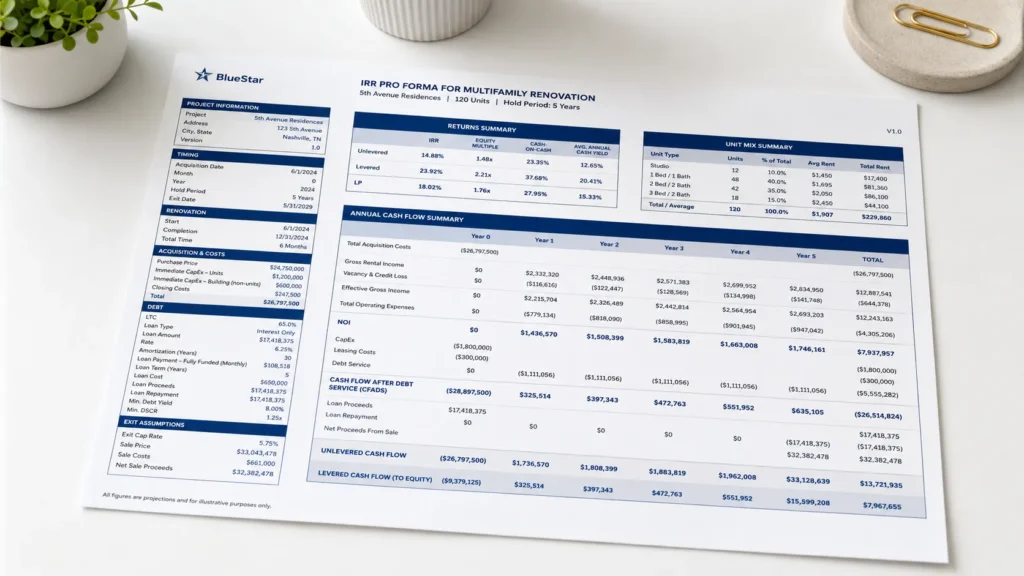
When IRR Misleads: Reading the Full Picture
IRR is the standard performance metric in commercial real estate because it accounts for both the amount and timing of returns. It also has well-documented blind spots.
A short hold with a high exit price produces a high IRR regardless of how little income the deal generated along the way. A longer hold with stable distributions may produce a more modest IRR but a higher equity multiple and materially stronger cash-on-cash yield for investors who need current income. The reinvestment assumption embedded in IRR also overstates actual performance when interim cash flows cannot be redeployed at the same rate.
This is why the equity multiple and cash-on-cash return appear alongside IRR in any serious underwriting exercise. A deal with a 22% IRR and a 1.4x equity multiple over three years is a different investment from one with a 16% IRR and a 2.3x equity multiple over five years. Both numbers are real. Neither tells the whole story on its own.
Frequently Asked Questions
What is IRR in real estate?
Internal Rate of Return (IRR) is the annualized rate at which the net present value of all cash flows from an investment equals zero. In real estate, it accounts for equity invested at acquisition, operating cash flows over the hold period, and proceeds from the eventual sale or refinance.
It is the most widely used return metric in commercial real estate underwriting because it accounts for the time value of money and the full lifecycle of the investment.What is a good IRR for a real estate investment?
The threshold depends on strategy and risk. Core stabilized acquisitions typically target 8 to 12 percent levered IRR. Value-add strategies typically require 15 to 20 percent to justify execution risk. Ground-up development generally targets 20 percent or higher to compensate for construction risk and the cash-negative pre-stabilization period. A meaningful benchmark compares the projected IRR against deals of the same type, leverage level, and hold period, not against all real estate as a category.
What is the difference between IRR and NPV?
IRR is a rate: the discount rate at which a project's net present value equals zero. NPV is a dollar amount: the value created above a required return. Both use the same discounted cash flow framework but answer different questions. IRR tells the investor what return the deal generates. NPV tells the investor how much value the deal creates at a specific required return. A positive NPV at an 8 percent discount rate means the deal beats an 8 percent hurdle. A negative NPV at the same rate means it does not.
What is Modified IRR (MIRR), and when should it be used?
Modified IRR (MIRR) corrects for one of standard IRR's known limitations: the assumption that interim cash flows are reinvested at the IRR itself, which overstates actual performance when interim distributions cannot be redeployed at the same rate. MIRR substitutes a more conservative reinvestment rate, typically the cost of capital or a risk-free rate, when compounding interim cash flows. It is most relevant for deals with high interim distributions relative to the equity invested.
Share on:
Our Services
Request a Consultation
Schedule a consultation to discuss your next development, acquisition, or market analysis needs
Recent Posts

Closing the Gap Between “We Think This Deal Works” and…
A deal rarely fails because the vision was wrong. It fails because the underwriting behind…

Net Absorption in Real Estate: What the Number Actually Signals
A submarket can show negative net absorption because tenants are leaving the market — or…

Absorption Rate in Real Estate: How to Calculate It and…
A submarket can show strong absorption and rising vacancy at the same time. It can…