
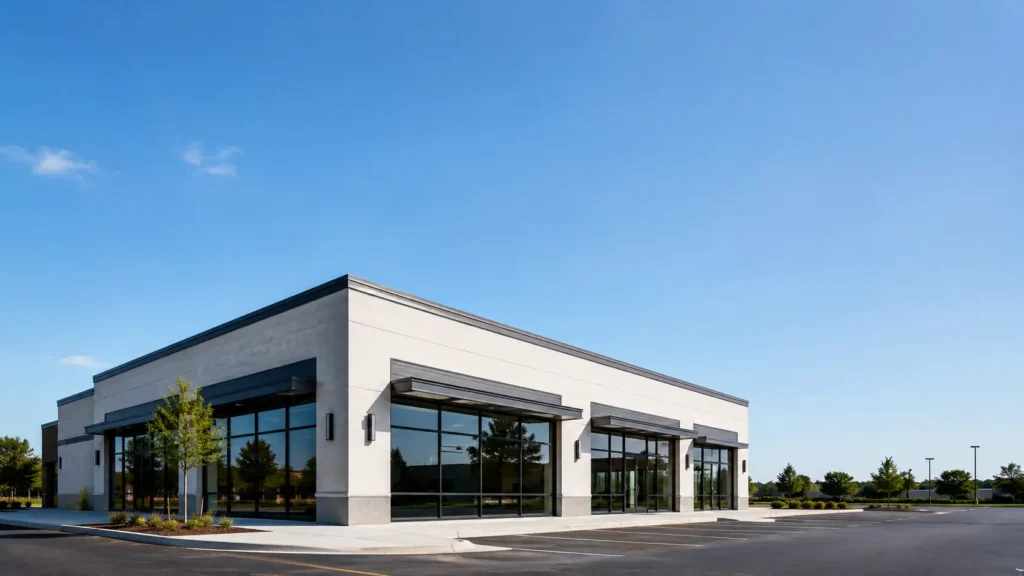
What NNN means in commercial real estate, why it has become the structure of choice for passive investors, and what every buyer and tenant must understand before executing a deal.
The Lease Structure Landscape
Before NNN makes sense, you need to understand what it’s contrasted against. Commercial leases exist on a spectrum defined by one central question: who pays for what?
GROSS LEASE MODIFIED GROSS NNN / TRIPLE NET Full-Service / Gross Modified Gross NNN / Triple Net Tenant pays flat rent. Landlord covers all operating expenses — taxes, insurance, maintenance. A negotiated split. Tenant and landlord share operating expenses in some agreed proportion. Tenant pays base rent plus all three nets — taxes, insurance, and maintenance. Expense Gross NNN Property taxes Owner Tenant Insurance Owner Tenant Maintenance Owner Tenant Utilities Owner Tenant Breaking Down the Three Ns
The “triple” in triple net refers to three specific expense categories the tenant agrees to absorb. Each is significant on its own. Together, they fundamentally shift the economics of property ownership.
N
Property Taxes
The tenant pays the annual property tax bill directly. If assessments rise, the tenant absorbs the increase, not the owner.N
Building Insurance
The tenant carries property and liability insurance on the building. The landlord is typically named as additional insured, but the premium is the tenant’s burden.N
Maintenance & Repairs
From routine upkeep to major repairs — HVAC, roof, parking lot — the tenant is responsible. In absolute NNN deals, even structural repairs fall to the tenant.In an absolute NNN lease, the landlord’s only job is to cash the rent check. No phone calls about broken HVAC. No surprise roofing bills. No insurance renewals to manage. That simplicity is worth a great deal, and the market prices it accordingly.
A Real-World Example
Consider a Starbucks-occupied drive-through building in a suburban market. The tenant has 15 years left on a corporate-guaranteed NNN lease with scheduled rent increases built in. Here’s what the economics look like:
ITEM ANNUAL AMOUNT PAID BY Base rent (tenant pays landlord) $115,000 Tenant → Landlord Property taxes $18,500 Tenant directly Building insurance $6,200 Tenant directly Maintenance & repairs $9,300 Tenant directly Landlord’s net operating income $115,000 Pure — no deductions The landlord receives $115,000 per year. Every dollar is NOI — there are no operating expenses to subtract because the tenant handles them all. At a 5.5% cap rate, this property is valued at approximately $2,090,000.
Why NNN Has Become the Darling of Passive Investors
The appeal is not complicated: NNN properties offer some of the most predictable, low-management income streams in all of real estate. For the right investor — a retiree seeking steady cash flow, a high-earner using a 1031 exchange, a family office seeking income with minimal operations — they can be extraordinarily attractive.
FOR THE LANDLORD / INVESTOR
Predictable income with no surprise expense calls.
Long lease terms (10–25 years) offer stability.
Rent escalations build in inflation protection.
Corporate guarantees reduce credit risk.
Ideal for 1031 exchange replacement property.
Easy to finance — lenders love stable NNN dealsFOR THE TENANT / BUSINESS OPERATOR
More control over the property and its condition.
Often lower base rent than gross lease alternatives.
Ability to customize and maintain the space.
Tax deductibility of operating expense payments.
Long-term location security for customer-facing brands.
Preferred by national chains for site consistencyTenant Quality: The Variable That Changes Everything
An NNN lease is only as valuable as the tenant behind it. A 15-year NNN lease with a publicly traded, investment-grade retailer is a completely different asset from a 15-year NNN lease with a regional operator of uncertain financial health.
TENANT TYPE EXAMPLES RISK LEVEL Investment-grade national McDonald’s, Walgreens, Dollar General, 7-Eleven, CVS Lowest risk Strong regional chains Popular regional grocers, healthcare operators, established franchisees Moderate risk Local / single-operator Independent restaurants, local services, small franchisees Higher risk Investment-grade tenants trade at compressed cap rates — sometimes 4% or below — precisely because the income is deemed nearly guaranteed. A local operator in the same building might require a 7–8% cap rate to compensate for the higher likelihood of default, vacancy, or renegotiation.
The phrase “NNN deal” tells you the structure. The tenant’s credit profile tells you whether to trust the income stream that structure promises to deliver.
Absolute NNN vs. Standard NNN: Know the Difference
These terms are often used interchangeably, but they are not the same thing, and the distinction matters considerably at the negotiating table.
In a standard NNN lease, the tenant pays taxes, insurance, and maintenance, but the landlord may retain responsibility for major structural components: the roof, the foundation, the exterior walls. If the roof fails, the landlord writes the check.
In an absolute NNN lease (sometimes called a “bondable” lease), the tenant takes on everything, including structural repairs. Theoretically, even a catastrophic loss that renders the building unusable does not relieve the tenant of their rent obligation. These leases command the lowest cap rates in the market because they most closely resemble a bond: fixed payments, no landlord responsibilities whatsoever.
Always read the lease — not just the marketing sheet. The phrase ‘NNN’ on a flyer tells you about intent. The actual lease document tells you who’s really responsible when the roof caves in.
What NNN Investors Need to Watch Out For
The passive income story is compelling. But NNN investing carries its own set of risks that catch the uninformed off guard.
- Lease expiration risk. A 20-year NNN deal sounds fantastic — until you realize 18 of those years have already elapsed. Short remaining lease terms dramatically reduce value and can leave you scrambling to re-tenant or sell a vacant building.
- Dark clauses and co-tenancy provisions. Some leases allow tenants to dramatically reduce rent — or terminate early — if anchor neighbors close or foot traffic falls below a threshold. These clauses can gut your income without warning.
- Compressed exit cap rates. Many NNN investors buy at low cap rates assuming they’ll sell at similarly low rates. If market cap rates expand during your hold period — as they did aggressively in 2022–2024 — your resale price could be significantly lower than purchase price, regardless of stable rent.
- Location dependency. NNN properties are frequently single-tenant buildings built specifically for one operator. If that tenant leaves, re-leasing a 3,000-square-foot drive-through coffee shop or a pharmacy configured for one brand can be extremely difficult without significant capital investment.
- Thin rent escalations. Many NNN leases include 10% bumps every five years — which sounds meaningful but rarely keeps pace with inflation over a 20-year term. What feels like a stable income stream can quietly lose real purchasing power year over year.
Why Every Commercial Real Estate Participant Should Understand NNN
Even if you never buy or lease a triple net property, understanding NNN is essential background knowledge for navigating commercial real estate broadly. Cap rates — which we explored in our previous post — are closely tied to lease structure. A property’s NOI means something different depending on whether it’s gross, modified gross, or NNN. The lease structure is the context that gives the numbers meaning.
For investors, NNN represents a specific point on the risk-return spectrum: lower yield, lower management burden, higher certainty. For tenants, it represents operational control with corresponding financial responsibility. For brokers and analysts, it’s the dominant structure in single-tenant retail — one of the largest segments of the commercial real estate market.
The language of NNN shows up everywhere: in listing descriptions, underwriting models, loan documents, and 1031 exchange searches. Fluency in that language is table stakes for anyone operating in commercial real estate.