
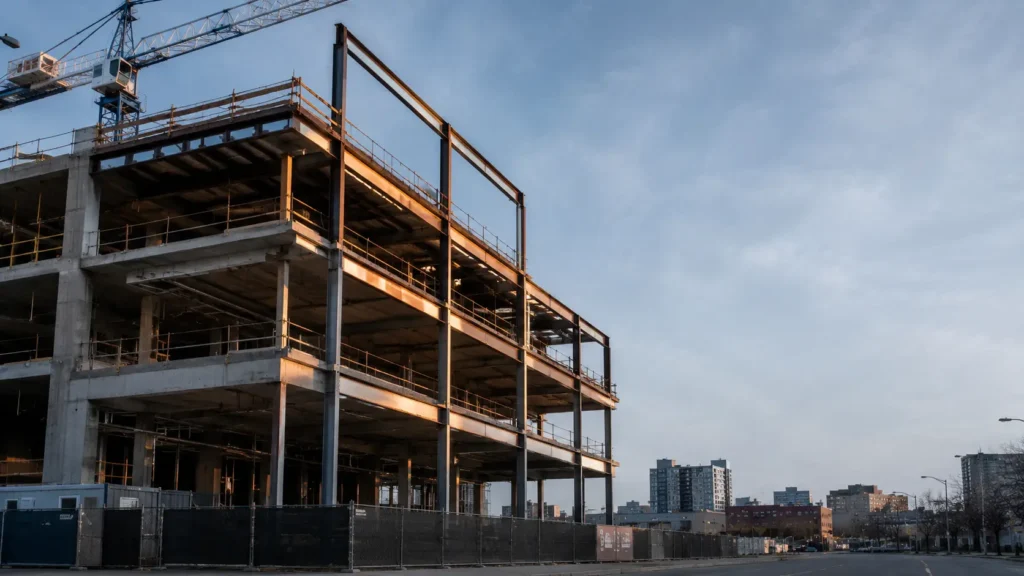
A development pro forma is built backwards from a property that does not yet exist. Unlike an acquisition model, which evaluates an asset with known income, a development model starts with a cost structure, projects a construction timeline, and only reaches operating income at the end of a build period that typically runs 18 to 36 months. The three numbers that determine whether the deal proceeds are return on cost, development margin, and levered IRR, in that order and for specific reasons this article explains.
A development pro forma is a financial model that evaluates the viability of a ground-up construction project by projecting all project costs, the construction financing structure, and the stabilized operating income produced at completion. It differs from an acquisition pro forma at the structural level: an acquisition model starts with existing income and discounts it to a present value; a development model starts with a cost budget and builds forward to projected income.
For development deals specifically, return on cost and development margin are more reliable primary metrics than IRR, and the section on return metrics explains why. You can use our free interactive IRR Calculator to run numbers for your project.
How a Development Pro Forma Differs from an Acquisition Model
The structural differences between a development and acquisition pro forma are not stylistic. They reflect fundamentally different risk profiles and cash flow timing. The table below maps the key distinctions.
| Dimension | Acquisition Pro Forma | Development Pro Forma |
| Starting condition | Existing asset with in-place income | Vacant land or pre-construction site, zero income |
| First cash flow | Year 1 operating income (immediate) | Month 19-24 or later, after construction completes |
| Primary cost inputs | Purchase price, renovation budget, closing costs | Land, hard costs, soft costs, financing costs, developer fee |
| Financing structure | Permanent loan at closing; immediate debt service | Construction loan drawn over 12-36 months; interest capitalizes during build |
| Revenue timing | Immediate, subject to existing lease terms | Delayed, then ramped over lease-up period |
| Key feasibility metric | Going-in cap rate, levered IRR, DSCR | Return on cost, development margin, levered IRR |
| IRR reliability | High, income-phase cash flows dominate | Lower, single discount rate applied to two structurally different risk phases |
| Lender primary test | DSCR on stabilized NOI | Loan-to-cost ratio, interest reserve coverage, stabilized DSCR |
The cash-negative period is the defining structural feature. During the construction phase, the development model shows only outflows: land payments, construction draws, soft cost invoices, and accruing interest on the construction loan. No income appears until units deliver and lease-up begins. That extended cash-negative period is why development deals require higher return thresholds than acquisitions of comparable asset types.
The Cost Structure: Sources and Uses
Every development pro forma begins with a sources and uses schedule. The uses side itemizes every dollar of project cost before the first dollar of income is projected. The sources side shows how that cost is funded across equity and debt.
BlueStar Consulting infographic: hard costs versus soft costs in ground-up real estate development, with typical percentage ranges for each line item and a total development cost allocation breakdown at the bottom.
BlueStar Consulting · Development Pro Forma Reference
Hard Costs vs. Soft Costs
Typical line items in a ground-up CRE development budget
Hard Costs
Direct construction expenditures
Soft Costs
Indirect project expenses
Typical total development cost allocation
55–65%
Hard Costs
15–20%
Soft Costs
10–20%
Land
5–8%
Financing
Line item ranges reflect % of total hard cost budget · Allocation figures reflect % of total development cost · bsreconsulting.com
Hard costs are direct construction expenditures: site work, horizontal improvements, structural framing, mechanical and electrical systems, interior finishes, and general contractor fees. Hard cost contingency, typically 5 to 10 percent of total hard costs, accounts for scope changes and unforeseen conditions during construction. Hard costs represent roughly 55 to 65 percent of total development cost on a market-rate multifamily project, depending on land basis, market, and building type.
Soft costs are indirect project expenses incurred before and during construction. Architecture and engineering typically run 4 to 6 percent of hard costs. Developer fee, representing the compensation for development risk and oversight, is modeled at 3 to 5 percent of total development cost and is a legitimate cost line that should appear in the uses schedule, not in the return projection. Legal, title, permits, and marketing round out the soft cost stack. Soft costs represent 15 to 20 percent of total development cost for most market-rate projects.
Land is treated as a day-one cost. Its share of total development cost varies significantly by market: 8 to 12 percent in secondary Sun Belt markets, 20 percent or higher in primary coastal markets with constrained supply. A high land basis compresses the development margin before a single unit is framed.
Financing costs include construction loan origination fees, typically 0.5 to 2 percent of the loan commitment, and the interest reserve. The interest reserve is the capitalized interest that accrues on the outstanding construction loan balance during the build period. It is not a fixed input, and the next section explains how it is calculated.
How the Construction Draw Schedule and Interest Reserve Work
The construction draw schedule is the timeline of cost disbursements from the construction loan. It is the most technically distinct element of a development model and the one most commonly misunderstood in underwriting submitted to construction lenders.
Construction costs do not disburse evenly. Spending follows an S-curve: slow in the early months as mobilization and site work proceed, accelerating sharply through the structural and enclosure phases, then tapering as punch-list items and certificate of occupancy work finish out. A standard 18-month multifamily construction timeline concentrates roughly 60 percent of hard cost disbursements in months 5 through 13.
The critical mechanic: construction loan interest accrues only on the drawn balance, not on the full loan commitment. On a $12,000,000 hard cost budget financed at 65 percent loan-to-cost (LTC) at 7.5 percent annual interest, the construction loan commitment is $7,800,000. But in Month 1, the drawn balance may be only $500,000 to $800,000. Interest in that month accrues on that small drawn balance, not on the full $7,800,000.
The simplified quarterly draw schedule below illustrates how the interest reserve builds:
| Quarter | Quarterly Debt Draw | Cumulative Debt Balance | Quarterly Interest Accrual |
| Q1 (Mo 1-3) | $702,000 | $702,000 | $13,163 |
| Q2 (Mo 4-6) | $936,000 | $1,638,000 | $30,713 |
| Q3 (Mo 7-9) | $1,170,000 | $2,808,000 | $52,650 |
| Q4 (Mo 10-12) | $936,000 | $3,744,000 | $70,200 |
| Q5 (Mo 13-15) | $702,000 | $4,446,000 | $83,363 |
| Q6 (Mo 16-18) | $234,000 | $4,680,000 | $87,750 |
| Total | $4,680,000 | $337,839 |
Total estimated interest reserve: approximately $338,000 on $4,680,000 of drawn debt over 18 months, representing roughly 7.2 percent of the total loan drawn. That figure is not fixed. A construction timeline that extends from 18 months to 24 months, a draw schedule that front-loads costs, or an interest rate that moves 50 basis points all change the interest reserve and therefore change the total development cost and the equity required at close.
Lenders who test a development pro forma will run the draw schedule themselves with their own timeline assumptions. A model that uses a flat monthly draw rate rather than an S-curve, or that calculates interest on the full loan commitment rather than the drawn balance, will not survive that test. It will also understate the true loan-to-cost if the interest reserve has not been properly included in the cost budget.
Absorption Timing and How Revenue Enters the Model
Revenue in a development pro forma does not appear at project start. It appears after construction completes, and it ramps over a lease-up period before reaching stabilization.
Absorption timing describes the rate at which completed units are leased. For a 90-unit multifamily building completing construction in Month 18, a typical base-case absorption assumption is 15 to 20 units per month, achieving 90 percent physical occupancy by Month 24 to 26. At that point, the asset is considered stabilized and the net operating income (NOI) reaches the level used for valuation and refinancing.
The absorption assumption is one of the most consequential inputs in the revenue section, and one of the most frequently optimistic. A lease-up that takes 24 months rather than the modeled 18 months adds six months of operating costs, six months of construction loan interest on any remaining outstanding balance, and six months of delay before the permanent financing event. That compounding effect on both cost and revenue timing can compress the levered IRR by 200 to 400 basis points, depending on the leverage ratio.
The revenue model during lease-up is not a flat NOI figure. Each month shows incremental income as additional units come online, offset by ongoing operating expenses on the full building. The first several months of operations often show negative cash flow as expenses run at full capacity while income is still ramping. Modeling this ramp accurately, rather than assuming stabilized NOI from the first month of operations, is a basic requirement for any model submitted to a construction lender or institutional equity partner.
Return on Cost, Development Margin, and Why IRR Is an Incomplete Primary Metric
Return on cost is the developer’s primary feasibility check before a pro forma is built at full depth. It is calculated as stabilized NOI divided by total development cost:
Return on Cost = Stabilized NOI / Total Development Cost
A project generating $3,500,000 in stabilized NOI on a $50,000,000 total development cost has a return on cost of 7.0 percent. Whether that return justifies the project depends on the spread between that yield and the prevailing market cap rate for the asset type at stabilization. According to Arbor Realty Trust’s May 2026 analysis, national multifamily cap rates averaged 5.8 percent over the prior 12 months.
A developer targeting a 150 to 200 basis point spread above that market rate needs a return on cost of approximately 7.3 to 8.0 percent to justify the construction risk. A return on cost that does not clear that spread signals that the project creates insufficient value above what an acquirer would pay for a stabilized asset at market pricing.
Development margin is the gross profit measure:
Development Margin = (Exit Value or Stabilized Asset Value – Total Development Cost) / Total Development Cost
A $65,000,000 stabilized asset value on a $50,000,000 total development cost produces a development margin of 30 percent. Most institutional developers require a minimum of 15 to 20 percent gross development margin before financing costs are applied, with higher thresholds for complex mixed-use projects or markets with elevated execution risk.
Why development IRR is an incomplete primary metric. Standard IRR applies a single discount rate to all project cash flows, from the first land payment through the final sale or refinance. In a development deal, those cash flows span two fundamentally different risk phases: the construction phase, which carries site risk, contractor risk, entitlement risk, and financing risk, and the stabilized income phase, which carries operating risk comparable to an acquisition. Applying a single discount rate to both phases overstates the return for the riskier phase and understates it for the lower-risk phase.
Return on cost and development margin are not subject to this distortion because they are calculated at stabilization only, after the construction risk has been resolved. Use development IRR as a directional return indicator and for LP presentation. Use return on cost and development margin as the primary feasibility tests.
How BlueStar Consulting Builds Development Pro Formas
BlueStar Consulting builds development pro formas for ground-up multifamily, mixed-use, and commercial projects across acquisition, pre-development, and construction lender presentation stages. Each model includes a full sources and uses schedule, an S-curve construction draw schedule with monthly interest accrual on the drawn balance, a phased lease-up revenue model, and all three return metrics presented in sequence: return on cost, development margin, and levered IRR.
Developers or general contractors preparing for a construction lender submission, a capital raise, or an investment committee presentation can engage BlueStar to build the model or to independently review and stress-test assumptions in an existing pro forma.
Development Pro Forma Frequently Asked Questions
What is a development pro forma and how is it different from a standard real estate pro forma?
A development pro forma is a financial model for a ground-up construction project. It differs from a standard acquisition or stabilized asset pro forma in that it starts with a cost budget rather than in-place income, projects a construction timeline during which all cash flows are negative, and only reaches operating income after construction completes and the lease-up period begins. The primary feasibility outputs are return on cost and development margin, not the cap rate or cash-on-cash return that dominate acquisition analysis.
What is the difference between hard costs and soft costs in a development pro forma?
Hard costs are direct construction expenditures: site work, structural and vertical construction, mechanical and electrical systems, interior finishes, and general contractor fees. Soft costs are indirect project expenses: architecture and engineering, legal and title, permits and fees, developer fee, and marketing. Hard costs typically represent 55 to 65 percent of total development cost on a market-rate multifamily project. Soft costs typically represent 15 to 20 percent. Both are included in the total development cost used to calculate return on cost and development margin.
How does interest accrue on a construction loan during the build period?
Construction loan interest accrues monthly on the outstanding drawn balance, not on the full loan commitment. Because construction costs follow an S-curve distribution, the drawn balance grows slowly in the early months, accelerates through the middle of the build, and decelerates toward the end. The total interest accrued over the construction period is the interest reserve, which is part of the total development cost and affects both the equity required at close and the true loan-to-cost ratio. A development pro forma that calculates interest on the full loan commitment from day one will systematically overstate the interest reserve and misstate the equity requirement.
What is return on cost and how is it used in a development pro forma?
Return on cost is stabilized NOI divided by total development cost. It is the unlevered yield on the developer’s total capital investment at the point of stabilization. Its primary use is as a feasibility check against the prevailing market cap rate for the asset type: if return on cost does not exceed the going-in cap rate by a sufficient spread, typically 150 to 200 basis points, the project does not create adequate value above what a developer could achieve by simply acquiring a stabilized asset. Return on cost is calculated before any financing structure is applied, which makes it independent of the leverage ratio and directly comparable across projects with different capital structures.
Why is development IRR considered less reliable than return on cost as a primary feasibility metric?
Standard IRR applies a single discount rate to all project cash flows regardless of when they occur or what risk phase they belong to. In a development deal, early-phase cash flows carry construction risk, entitlement risk, and financing risk that are structurally different from the operating income that follows stabilization. Applying one discount rate to both phases produces a single number that does not accurately represent either phase’s risk-adjusted return.
Return on cost and development margin are calculated at stabilization, after the construction risk has resolved, and are not subject to this distortion. IRR remains useful for LP return presentations and cross-deal comparisons, but it should not be the first feasibility test and should always be presented alongside return on cost and development margin in a complete analysis.
What does a construction lender stress-test in a development pro forma?
Construction lenders typically test four elements independently of the sponsor’s base case projections. They test the draw schedule by substituting their own timeline assumptions to verify that the interest reserve holds under a delayed construction scenario. They test the lease-up assumptions by reducing the absorption rate to determine how long the property can sustain carrying costs before stabilized DSCR is achieved. They test the total loan-to-cost by confirming that the interest reserve has been correctly included in the total development cost and that the true LTC is within their maximum threshold.
Finally, they test the exit by applying a stress cap rate to stabilized NOI to confirm that the reversion value supports loan repayment under adverse market conditions. A model that has not been pre-stressed against these four tests before submission will not clear underwriting without multiple rounds of revision.